Do You Even Document, Bro?
Do you even document, bro? Information management practices in technology start-ups.
Author Note
This paper is based on research originally conducted in partial fulfilment of the requirements for the Master of Science degree in Information Management at The Robert Gordon University, completed in June 2017 under the supervision of Dr Graeme Baxter.
The paper was presented at the RAILS Conference (Research Applications in Information and Library Studies) in November 2017.
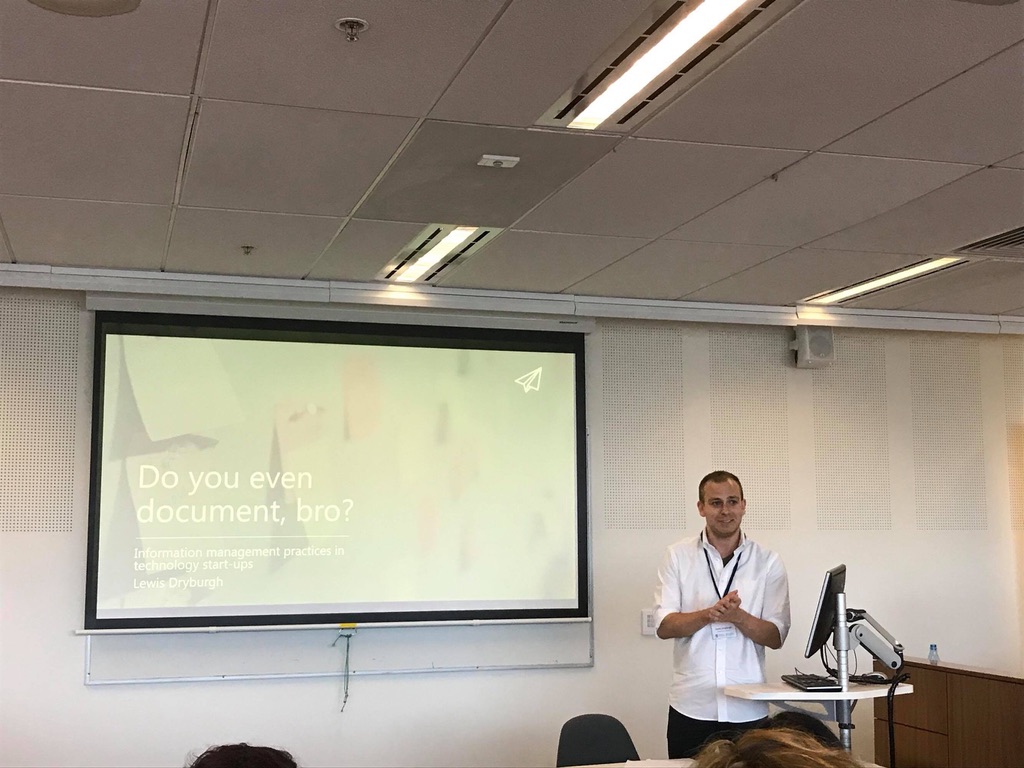
The original dissertation has been adapted while maintaining the integrity of the research findings and methodology. If you’d like to read the original dissertation, please get in touch and I’ll send you a PDF.
Abstract
This paper investigates how early-stage technology start-ups manage internal business information. Semi-structured interviews were conducted with five founders across four Sydney-based start-ups, complemented by observation of routine information retrieval. Guided by grounded theory analysis, six themes related to start-up information management were identified: use of digital-only information environments, chat-centric communication, informal governance anchored in cultural norms, search-first retrieval, retention by default with minimal deletion, and novel governance practices including wiki-based knowledge capture and automated code linters. These practices appear to enable functional governance in resource-constrained environments, though questions remain about scalability, fragmentation, and long-term retention. Implications for practice and future research directions are provided.
Keywords: information management; start-ups; information governance; knowledge sharing; cloud collaboration
1. Introduction
Information is a core organisational resource, shaping performance and capabilities (Smallwood 2014). Research on information governance, knowledge management and organisational learning has largely centred on established firms with formal structures. In contrast, start-ups operate under constraints of speed, uncertainty and scarcity, typically lacking procedural maturity. Understanding how start-ups manage business-critical information is therefore an unresolved problem.
This exploratory study examines the internal information practices of four Australian technology start-ups. The concept of business information refers to internal documentation, organisational knowledge and operational records, distinct from customer-facing product or service data. The study asks two core questions:
- How do technology start-ups create, store, retrieve and dispose of internal business information?
- Which practices or structures, if any, represent innovative approaches to information governance?
2. Literature Review
2.1 Defining Start-ups
Definitions of “start-up” are plural and contested. Zaech and Baldegger (2017) note the absence of any consensus definition. This study adopts a pragmatic approach aligned with Ries (2011), defining the start-up as a human institution oriented toward creation of new products or services under high uncertainty. Operational criteria supplement this definition: self-identification as a start-up, organisational age below five years, staff count below ten, and pursuit of scalable software products.
2.2 Information Management in Small Organisations
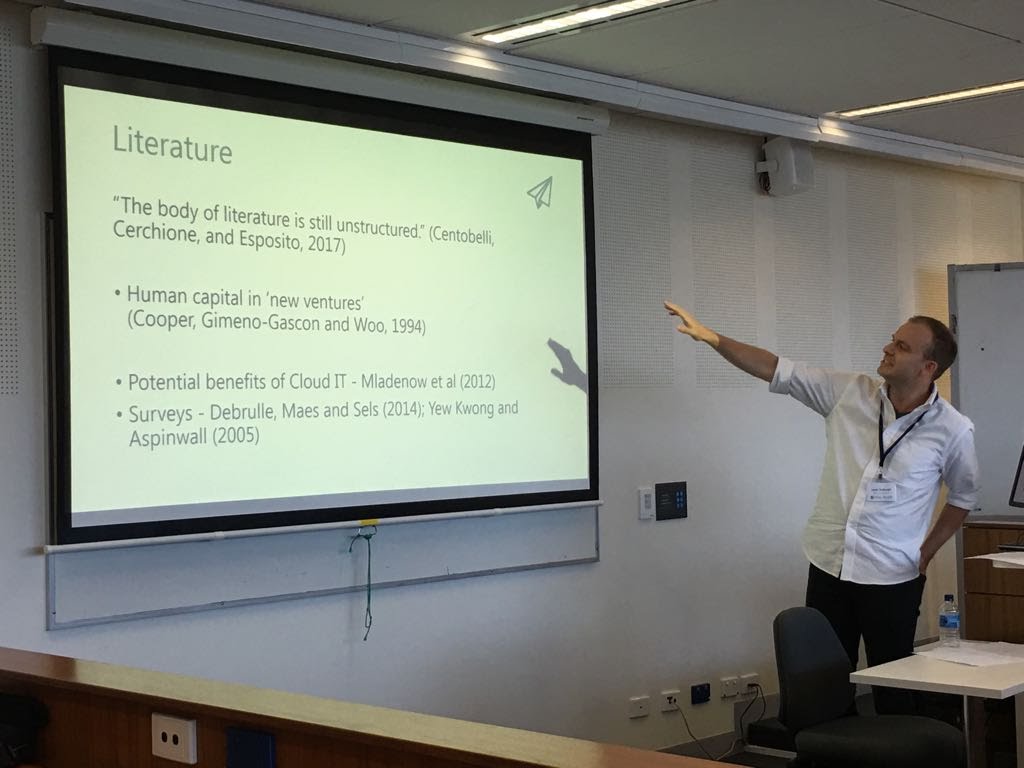
Research addressing internal information management in very small or early-stage firms is limited. Related scholarship emphasises knowledge acquisition (Sullivan and Marvel 2011), absorptive capacity (Debrulle et al. 2014) and technology adoption (Mladenow et al. 2012), but rarely examines the internal practices by which business information is stored, retrieved and governed. Centobelli et al. (2017) conclude that knowledge management literature in start-ups remains fragmented and under-theorised.
2.3 Methodological Precedent
Qualitative approaches are central to examining information practices. Grounded theory has been used to investigate information architectures (Burford 2014) and organisational information systems (Urquhart et al. 2010; Mattarelli et al. 2013). Its bottom-up analytic logic is suited to emergent socio-technical phenomena where formal structures are absent or immature.
3. Methodology
3.1 Research Design
A qualitative research design was used, consisting of semi-structured interviews and in-situ observation. Grounded theory principles (Strauss and Corbin 1994) guided coding and theme development. The study privileged the participants’ descriptions of their lived information practices rather than evaluating them against normative frameworks.
3.2 Participants and Sampling
Purposive sampling identified four Sydney-based start-ups whose core products involve information-intensive services. All organisations met the operational criteria and self-identified as start-ups. Five founders participated in total.
Pseudonyms based on chemical elements were used to protect confidentiality; individuals were named after associated discoverers.
Table 1. Participating organisations
| Organisation | Product Type | Employees |
|---|---|---|
| Sodium | Recruitment platform | 6 (mostly part-time) |
| Lithium | Asset management software | 3 |
| Caesium | Business intelligence software | 3 |
| Rubidium | Real-time transport software | 3 |
3.3 Data Collection
Semi-structured interviews (45–75 minutes) followed a simplified information lifecycle model: creation, storage, retrieval and destruction. Interviews were audio-recorded and transcribed verbatim. Observation tasks involved participants demonstrating how they locate specific information within existing systems.
3.4 Data Analysis
Two-stage coding was applied:
- Open coding: descriptive and concept-level codes per transcript
- Focused coding: aggregation into cross-case thematic categories aligned with the research questions
Data were iteratively compared, refined and re-coded following grounded theory practice.
3.5 Ethics
Ethical approval was obtained from the host institution. Participation was voluntary and confidential, and observation components were optional. No commercially sensitive or proprietary data were requested or retained.
4. Results
The findings reveal six core themes that jointly characterise information management in the participating organisations.
4.1 Cloud-first, fully digital information environments
All firms operated exclusively with digital information. No physical files or paper systems were reported. Participants associated the digital-first stance with mobility, searchability and multi-user access.
Cloud-based tools formed the backbone of organisational information systems. Storage and communication relied on consumer SaaS: Google Drive, Dropbox, Slack, Facebook Messenger, Xero, InVision and Confluence.
A consequence of this digital-first ecology was the normalised assumption that every artefact should be stored centrally and remain accessible to the whole team.
“We don’t really think about where things go, we just put it in Drive and people can get it.” (Humphry, Sodium)
4.2 Chat-centric communication instead of email
All organisations expressed a preference for persistent chat systems. Email was reserved for external-facing communication or formal interactions. Slack and Messenger played dual roles as communication channels and ad hoc knowledge repositories.
One participant described Slack history as “half our documentation,” reflecting the porous boundary between synchronous interaction and knowledge capture.
One participant described Slack history as “half our documentation,” reflecting the porous boundary between synchronous interaction and knowledge capture.
4.3 Informal governance anchored in cultural norms
No organisation had a formal information policy or documented governance framework. Governance practices were implicitly embedded through shared expectations, workplace trust and founder preferences.
“We just assume people will be sensible. If something is important, you’ll put it somewhere where others can find it.” (William, Lithium)
Despite the informal nature of governance, no participant reported incidents of permanent data loss. Participants framed governance as a cultural matter, not a procedural one.
4.4 Search-first retrieval with ad hoc taxonomies
Search constituted the default retrieval strategy. Participants seldom navigated folder hierarchies; they issued keywords to system-level search boxes. When search failed, they asked colleagues.
Carl from Caesium noted that “if you don’t know it exists then you can’t search for it – or it’s very hard to search for it.”
Folder hierarchies existed but functioned as subjective taxonomies under the control of whoever created them. Naming conventions varied by individual or team and were rarely documented.
4.5 Retention by default and minimal deletion
Deletion was infrequent and often avoided. Storage was viewed as inexpensive and future value unpredictable.
Information is kept freely because “storage is cheap [and] space is cheap” (Robert, Rubidium).
The exception was Rubidium, which deliberately deleted user analytics after thirty days to prioritise privacy and reject monetisation strategies incompatible with organisational values.
4.6 Novel governance practices: Wiki-based knowledge capture and automated linters
Two distinctive practices emerged.
Comprehensive wiki. Rubidium maintained a Confluence wiki containing technical notes, deployment procedures, design decisions and incidental knowledge. Contribution was actively encouraged. The wiki served as a repository for information that might “otherwise end up as an email, as scratchings on a bit of paper, as a chat in an IM log, or something that never got shared at all.”
Automated linters. Rubidium enforced more than 200 coding standards through a linter that blocked non-compliant commits. This embedded organisational rules into development workflows and improved the quality and consistency of code documentation.
These mechanisms served as tool-based governance, bypassing formal policy artefacts.
Table 2. Themes, empirical indicators and illustrative quotations
| Theme | Empirical indicators | Illustrative quotations |
|---|---|---|
| Digital-only ecosystem | No paper files; SaaS platforms (Drive, Dropbox, Confluence) | All start-ups operated exclusively with digital information |
| Chat over email | Slack or Messenger as primary workspace | Slack history described as “half our documentation” |
| Informal governance | Norm-based expectations; trust | Humphry described information handling among colleagues as “generally pretty good… the people we’ve got are pretty sensible with their data collection and storage” (Sodium) |
| Search-based retrieval | Keyword-first; fallback to colleagues | “if you don’t know it exists then you can’t search for it – or it’s very hard to search for it” (Carl, Caesium) |
| Retention culture | Avoiding deletion; cheap storage | “storage is cheap [and] space is cheap” (Robert, Rubidium) |
| Tool-enabled governance | Confluence wiki; linter enforcing rules | Linter with over 200 rules blocks non-compliant commits (Rubidium) |
5. Discussion
Start-ups in this study display a consistent pattern of cloud-first, tool-mediated information management. Rather than documenting governance, they rely on tacit conventions and embedding of rules into digital tools. These practices enable coordination with minimal overhead and reduce cognitive burden in contexts of limited time and staffing.
The strong cultural emphasis on openness and shared access aligns with literature on entrepreneurial collaboration. However, search fragmentation, reliance on individual taxonomies and undocumented conventions may hinder scaling, onboarding and auditability.
Automated code governance and wiki-led incidental knowledge capture represent defensible innovations. They point toward a broader concept of governance by automation, where tools perform regulatory functions typically reserved for policy and compliance documents.
6. Limitations and Future Research
The study involves a small, geographically localised sample of male founders and may not generalise to other cultural or organisational contexts. Future work should:
- Track longitudinal change as start-ups grow and formalise structures
- Include non-founder employees and cross-functional roles
- Investigate automation in information governance at scale
- Examine how retention cultures adapt to regulatory or investor pressure
7. Conclusion
Technology start-ups manage business information using lightweight, tool-centric systems that prioritise collaboration, speed and accessibility. Formal governance frameworks are substituted by norms and automation. Cloud services, searchable communication platforms and wikis provide sufficient operational capability for small teams, though scalability risks remain. Understanding these practices expands knowledge of information management in emerging organisations and suggests new research trajectories for governance automation and digital-first knowledge capture.
References
Burford, S. (2014). A grounded theory of the practice of web information architecture in large organizations. Journal of the Association for Information Science and Technology, 65(10), 2017–2034.
Centobelli, P., Cerchione, R., and Esposito, E. (2017). Knowledge management in startups: systematic literature review and future research agenda. Sustainability, 9(3), 361.
Cooper, A. C., Gimeno-Gascon, F. J., and Woo, C. Y. (1994). Initial human and financial capital as predictors of new venture performance. Journal of Business Venturing, 9(5), 371–395.
Debrulle, J., Maes, J., and Sels, L. (2014). Start-up absorptive capacity: Does the owner’s human and social capital matter? International Small Business Journal, 32(7), 777–801.
Mattarelli, E., Bertolotti, F., and Macrì, D. M. (2013). The use of ethnography and grounded theory in the development of a management information system. European Journal of Information Systems, 22(1), 26–44.
Mladenow, A., Bauer, C., Strauss, C., and Decker, H. (2012). Value creation using clouds: Analysis of value drivers for start-ups and SMEs in the textile industry. Advanced Information Networking and Applications Workshops (WAINA), 1215–1220.
Ries, E. (2011). The Lean Startup: How today’s entrepreneurs use continuous innovation to create radically successful businesses. Crown Business.
Smallwood, R. F. (2014). Information Governance: Concepts, Strategies, and Best Practices. John Wiley & Sons.
Strauss, A. and Corbin, J. (1994). Grounded theory methodology. In Handbook of Qualitative Research, 17, 273–285.
Sullivan, D. M. and Marvel, M. R. (2011). Knowledge acquisition, network reliance, and early-stage technology venture outcomes. Journal of Management Studies, 48(6), 1169–1193.
Urquhart, C., Lehmann, H., and Myers, M. D. (2010). Putting the theory back into grounded theory: Guidelines for grounded theory studies in information systems. Information Systems Journal, 20(4), 357–381.
Zaech, S. and Baldegger, U. (2017). Leadership in start-ups. International Small Business Journal, 35(2), 157–177.